Menu
TURKEY’S FIRST CLIMATE LAW ADOPTED BY THE GRAND NATIONAL ASSEMBLY
Turkey’s first Climate Law has been enacted by being approved in the General Assembly of the Grand National Assembly of Turkey.
The Law covers the fundamental principles of reducing greenhouse gas emissions and climate change adaptation activities, including planning and implementation tools, revenues, permits, inspections, and the legal and institutional framework. The Law introduces key definitions such as “Just Transition”, “Primary Market”, “Offsetting”, “Emissions Trading System (ETS)”, “Embedded Greenhouse Gas Emissions”, “Voluntary Carbon Markets”, and “Climate Justice”.
In line with the general principles set out in the Law, Turkey’s efforts to combat climate change will be based on the principle of “common but differentiated responsibilities and respective capabilities”, while also embracing equality, climate justice, precaution, participation, integration, sustainability, transparency, just transition, and progress.
Public institutions and organizations, as well as individuals and legal entities, will be obliged to comply with and implement the measures and regulations taken in the public interest in a timely manner.
In the Nationally Determined Contribution (NDC), Turkey’s development priorities and specific national circumstances will be taken into account in alignment with the net zero emissions target, and measures will be adopted accordingly.
In addition, relevant public institutions will take measures to reduce the impacts of climate change on ecosystems and biodiversity, ensure the sustainable management of ecosystems, protect marine and terrestrial protected areas by increasing their quality and quantity, and achieve land degradation neutrality in areas affected or potentially affected by climate change. Measures will also be implemented to combat desertification and erosion, and to sustainably manage carbon sinks established on non-forest lands in line with the net zero emissions goal.
Importantly, the Climate Law does not impose any obligations on small tradespeople and artisans.
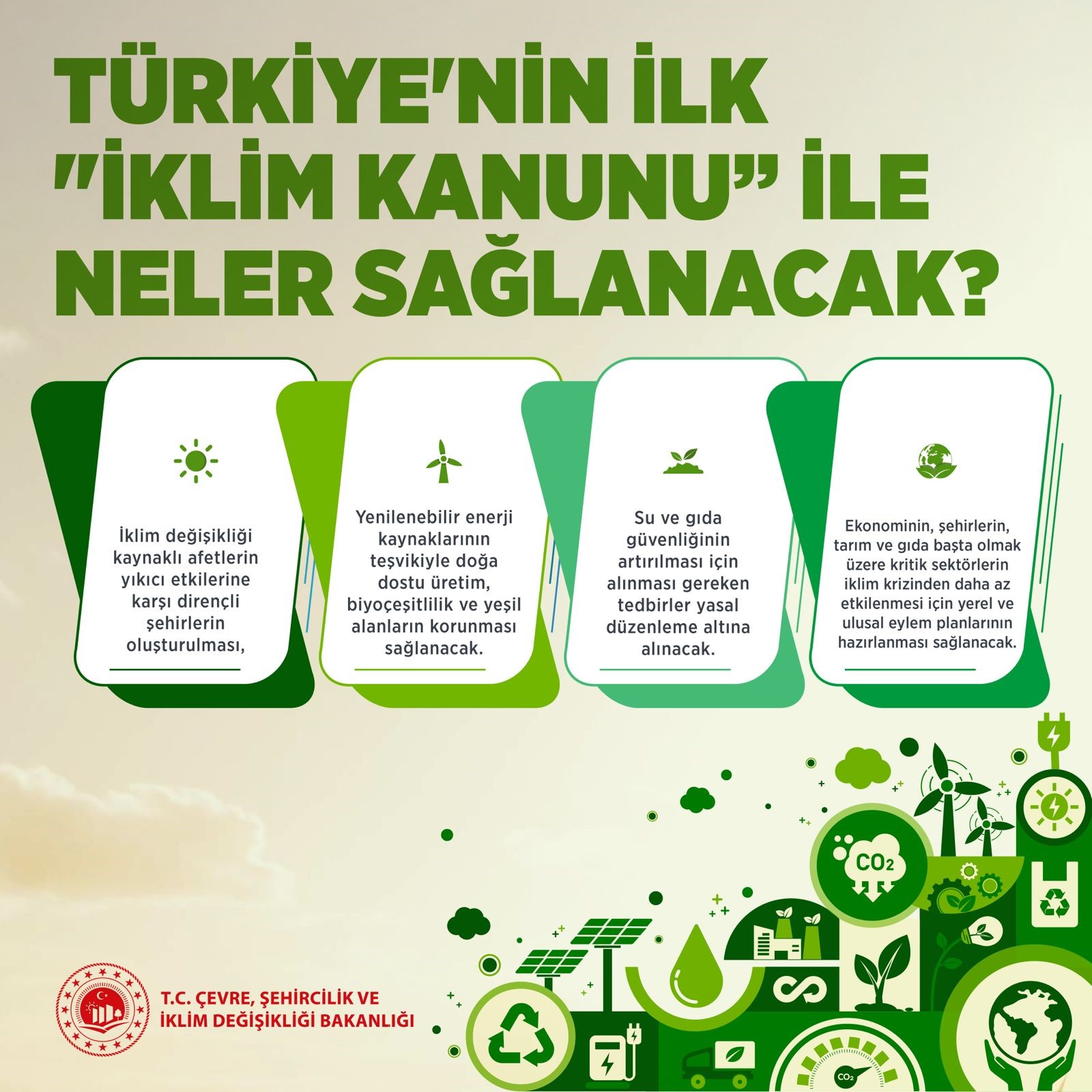
The Climate Law Will Contribute to the Following Areas:
- Cleaner and more efficient production processes
- Enhanced responsibilities for the Climate Change Presidency
- More effective development of national and local action plans
New Mechanisms Introduced by the Law:
- Establishment of Provincial Climate Change Coordination Boards
- Local plans to be prepared under the leadership of governors
- Creation of a Turkish Green Taxonomy
- Potential implementation of a Carbon Border Adjustment Mechanism
- Formation of a Carbon Market Board to define trade policies for imports and exports
- Promotion of clean technology adoption
- Inclusion of climate change and green transition in school curricula
- Development of early warning systems for disasters and solutions to ensure food security
- Integrated water management and land degradation neutrality
Timeline:
- Action plans must be completed by December 31, 2027